
EU Digital Policy: Action Over Talk

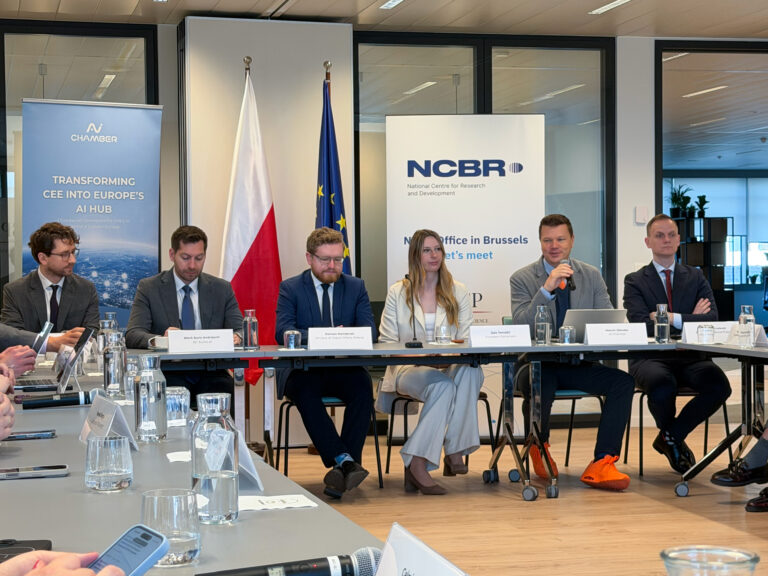
Today, in collaboration with our partners – Business Science Poland and National Centre for Research and Development – we convened a high-level policy roundtable in Brussels to address the issue of “digital simplification”, as envisaged by the European Commission in the Digital Omnibus Package.
With the AI Omnibus moving into the final stages of trilogues and the Digital Omnibus package being discussed in the Council under the Cyprus Presidency, we brought together key voices, including representatives of the Council. EP and European Commission, as well as the European business community (Digital Poland, EUTA, L’AFEP), to ask a blunt but key question: is this a “Cosmetic Cleanup or Real Simplification”? In other words – will these files actually help the European economy get back on track, or are we still rearranging the deck chairs on a sinking ship?
The discussion was kicked off with interventions from Secretary of State Mr. Dariusz Standerski and MEP Zala Tomaśić, who gave their respective perspectives on the simplification processes in the Council and European Parliament.
The fact that Europe’s competitiveness is stalling and the overregulation is one of the key factors is no longer up for debate. For years, our community has warned that the sheer volume of overlapping digital rules is acting as a tax on innovation, and the room was unanimous that radical simplification is now long overdue. While we see the Digital Omnibus as a necessary first step in the right direction, it is only a start. The credibility of the European project now rests on this package delivering tangible, structural relief – not just procedural tweaks.
We are deeply concerned by reports that the Cyprus Presidency is considering stripping away the most impactful improvements from the original proposal. If the Omnibus is hollowed out to satisfy bureaucratic inertia and vested interests, it will be a missed opportunity that Europe simply cannot afford and a very bad signal for the future. We must move away from a policy culture where rules are based on abstract moral principles with no regard for real-world outcomes. Several strong voices during the session called for a fundamental shift toward robust impact assessments that prioritize actual results over procedural checkboxes.
The discussion also touched on Enrico Letta’s proposed “28th regime”. While the idea of a unified EU framework for company law is promising, it may be nullified if 27 national administrations are still allowed to undermine it with “gold-plating” and divergent local obligations. A single market, be it for services, data or AI only works if the rules are truly single and cross-border trade doesn’t come with additional risk or expense.
The participants did not see a clear outcome of the debate over “cookie consent.” We all know the current system is a failure of “consent theater,” but shifting that burden to the browser level is a simplistic fix that doesn’t solve the underlying problem and can have negative side effects.
Several participants mentioned that more consistency is needed from the EC, as we are simplifying on one hand, but introducing new legislative proposals such as the Digital Fairness Act on the other, which runs the risk of introducing additional layers of complexity.
An important message to the business community is this: be louder and bolder in engaging the Brussels policymakers. Opponents of deregulation are well-organized and quick to demonize any attempt to reduce administrative burdens. If we don’t speak up now, we will continue to watch our best engineers and startups leave for more competitive markets. We have spent years talking about the problem; as the Omnibus moves forward, it is finally time for Europe to act.
We would like to extend our sincere thanks to Minister Standerski and MEP Tomašič for their leadership and for engaging in such a direct, “no-holds-barred” discussion with the business community. And a great thank you to our hosts and partners BSP and NCBR and of course to the participants for their time and great insights.
· More articles

Start of AI Chamber
The inauguration of the AI Chamber (Chamber of AI) took place in Warsaw, a newly established institution uniting dozens of startups, companies, organizations, and AI NGOs in Poland, and eventually across the entire CEE region. This is an important voice in the community because in a world of misinformation, changing narratives, interests, and, let’s not […]

European AI Act – AI Chamber Members’ Meeting
European AI Act – AI Chamber Members’ Meeting On October 28, 2024, AI Chamber members met to discuss the implications of the AI Act for the AI ecosystem. Led by Mikołaj Sowiński and Michał Kalinowski from the law firm SK&S Legal, the session clarified roles such as suppliers, users, distributors, importers, and authorized representatives under […]